The Strategic Spectrum: Mastering Office Color Psychology in 2026
The Psychology of
The Palette.
In the hyper-competitive corporate hubs of Addis Ababa—from the high-rises of Kazanchis to the commercial centers of Bole—the office is no longer just a "place to sit." It is a psychological engine. As we move into 2026, forward-thinking Ethiopian firms are moving beyond "standard white" to embrace Neuro-Design: the science of how color wavelengths impact human cognition.
"Design is not just what it looks like. Design is how it makes the brain behave. In Ethiopia, we must account for high-altitude sunlight and its interaction with the indoor spectrum."
Color choice is not a subjective "art"; it is a neuro-physiological intervention. When light enters the eye, it hits the retina and sends signals to the hypothalamus—the part of the brain responsible for heart rate, blood pressure, and circadian rhythms.
01. The Physics of Wavelengths
Every color has a specific frequency. Short-wavelength colors (Blues/Greens) are mentally calming, while long-wavelength colors (Reds/Yellows) are physically stimulating.
The High-Altitude Factor (The Addis Constant):
Addis Ababa sits at 2,355 meters. The UV index is higher, and the natural light has a "sharper," bluer tint than in lowland cities like Dubai or Nairobi. This means that "Cool Grey" paint—which looks modern in a catalog—often feels "dead" or "depressing" under the intense Ethiopian sun. At Duka Interiors, we compensate by introducing warm-undertones into every neutral we specify.
Fig 1.1: Chromatic Wavelength Impact on Cortisol Levels
02. Deep Dive: The Four "Primary" Office Moods
BLUE: The Cognitive Anchor
Best For: Deep focus, data entry, and legal research.
Blue stimulates the mind rather than the body. It lowers heart rate and respiratory rhythm. If your team is struggling with high error rates in spreadsheets or reports, the culprit is often a lack of blue-spectrum saturation in their visual field.
YELLOW: The Creative Catalyst
Best For: Marketing, Graphic Design, and Innovation Hubs.
Yellow is the "Emotional" color. It affects the ego and spirits. In a city like Addis where tech start-ups are booming, yellow-pulsed breakout zones are essential to prevent "writer's block" and keep spirits high during late-night sprints.
GREEN: The Balance Point
Best For: HR, long-hour workstations, and wellness rooms.
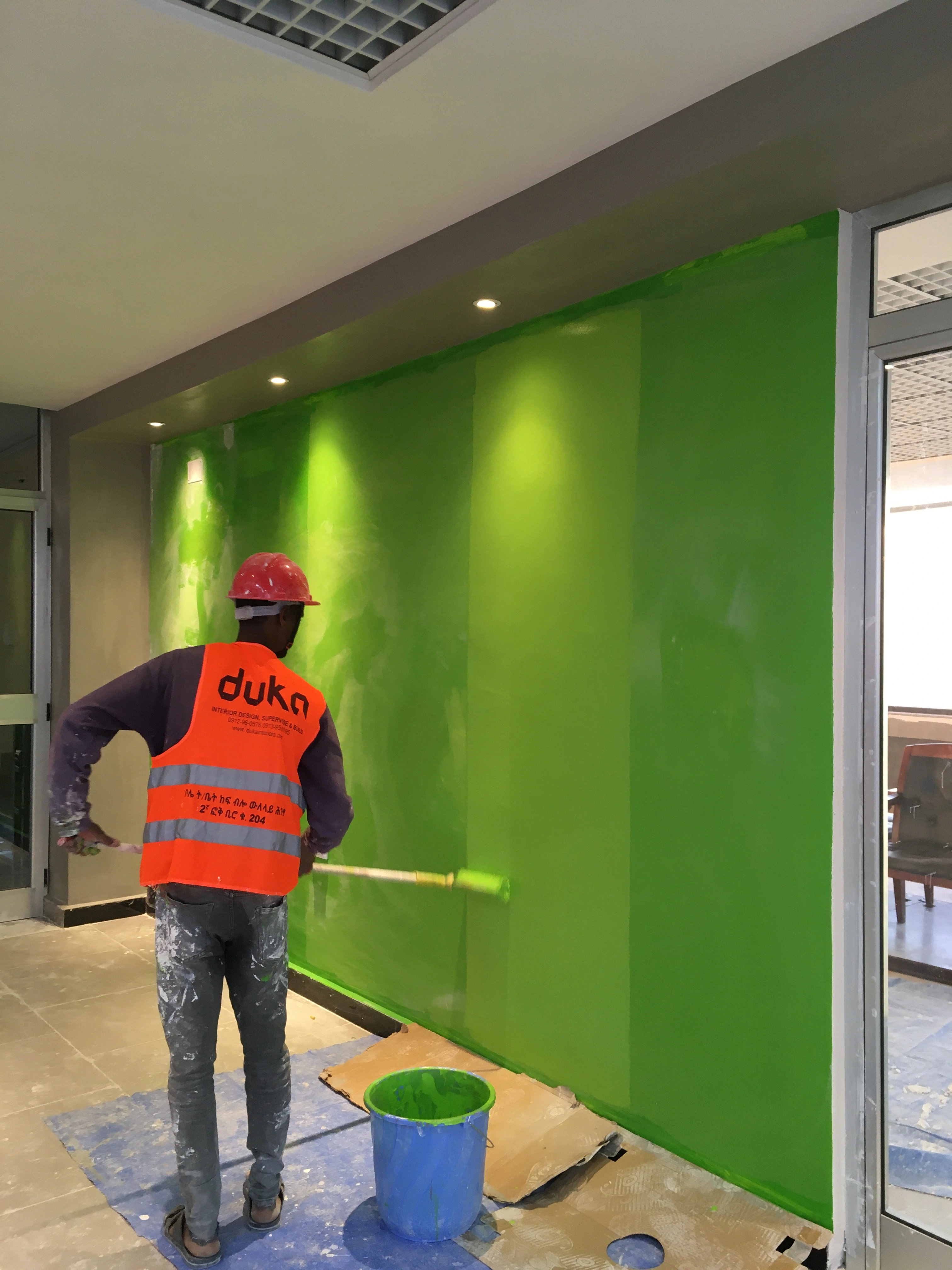
Green sits in the center of the spectrum. It requires zero ocular adjustment. It is the color of Biophilia. For offices with limited natural light in dense Addis neighborhoods, "Sage Green" mimics the restfulness of nature, reducing eye strain significantly.
RED: The Physical Engine
Best For: Sales floors, gyms, and high-energy negotiation.
Red increases heart rate and blood pressure. It is a "time-distorter"—it makes people think time is passing faster than it is. While too much red causes aggression, a red-infused sales floor in Bole can drive "urgency" in closing deals.
03. The 60-30-10 Rule: Engineering Balance
The most common mistake in Addis offices is over-saturation—painting every wall a bright brand color. This leads to "Chromatic Fatigue." To build a sustainable productivity environment, Duka Interiors utilizes the 60-30-10 Mathematical Framework.
60% Dominant (The Foundation): Usually a "Warm White" or "Light Greige." This covers the walls and ceilings. It maximizes the bounce of natural light from your windows, reducing the need for artificial overhead lighting during the day.
30% Secondary (The Mood Regulator): This is applied to larger furniture pieces, floor finishes, or a primary accent wall. This color dictates the "vibe" of the department—Blue for Legal, Green for Operations.
10% Accent (The Brand Pulse): This is where your brand identity lives. Cushions, small decor, or window mullions. By keeping high-intensity colors to 10%, you create "visual landmarks" that guide the eye without overwhelming the brain.
04. Beyond Paint: The Psychology of Materials
Color psychology isn't limited to paint; it extends to the tactile reality of the materials we use in Ethiopian manufacturing.
Organic Wood (The Cortisol Killer)
Visible wood grain in furniture—whether Oak, Walnut, or High-End Laminate—is proven to lower cortisol (stress) levels. In high-pressure environments like the Addis Financial District, introducing wood-texture desks provides a "natural grounding" effect that synthetic whites cannot match.
Metallic Accents (The Precision Anchor)
Brushed aluminum or matte black steel frames convey stability, logic, and precision. We specify these for engineering firms and tech startups to psychologically reinforce the "structural integrity" of the work being done.
The "Addis Glare" Mitigation: Because of the intense sun, we recommend "Matte" or "Satin" finishes for all office surfaces. High-gloss finishes create reflected glare (specular reflection), which causes the pupils to constantly constrict and dilate, leading to "3 PM Headaches" for staff seated near windows.
05. The Productivity Audit: A 2026 Checklist
Is your current office hurting your bottom line? Ask these three questions:
-
1
Are your hallways "Corporate Grey"?
If yes, you are inducing "Transition Boredom." Add a 10% accent of your brand color to re-energize staff as they move between meetings.
-
2
Do you have a "Quiet Room" for deep work?
This room should be 80% Blue or Sage Green. Zero red, zero yellow. It is a sensory-deprivation tank for high-value thinking.
-
3
What is the color of your Canteen?
If it's too white, it feels like a hospital. Warm Terracotta or Moss Green fosters social bonding and faster digestion.
Build a Space That
Wins.
Duka Interiors doesn't just sell furniture; we engineer the atmospheric conditions for your company's growth. From the Financial District to Bole, we are redefining the Ethiopian workspace.
Need Professional Finishing?
Request a technical site visit for your office project.