The Ethiopian Office Blueprint: Real-World Dimensions for Desks, Workstations, Storage, Soft Furnishings & Breakout Zones
The Ethiopian Office Blueprint:
Real Dimensions That Work in Addis Ababa.
In today's Addis Ababa, where prime office space in Bole or Kazanchis commands premium rents, every square meter must earn its keep. Poorly sized furniture doesn't just look awkward—it wastes rent, disrupts workflow, and forces costly reconfigurations months after move-in.
This guide is not about aesthetics or trends. It is a practical, field-tested reference for business owners, facility managers, and project leads who understand that office planning begins not with color palettes—but with dimensions. When desks are too wide, circulation paths vanish. When storage units ignore clearance rules, fire exits become obstructed.
Proper furniture sizing is the silent foundation of spatial efficiency. It determines how many people you can comfortably accommodate, how smoothly teams move through the space, and whether your layout supports focus, privacy, and interaction—all without expanding your footprint. In markets where commercial real estate is among the most expensive in East Africa, getting these measurements right from day one isn't optional—it's a financial imperative.
Based on 47 real projects across Addis Ababa, Bole, Kazanchis, and the Financial District, this blueprint reflects what actually works in Ethiopian offices—not theoretical standards that fail under local conditions.
01. Single Desks: The Physics of Personal Space
Single desks remain essential for managers, finance staff, and roles requiring document privacy. But in a high-rent environment, we must distinguish between "status" and "utility."
The Executive Desk (The Power Anchor):
Dimensions: 180W × 85D × 75H cm.
In the Ethiopian context, the Executive desk often serves as a secondary meeting table. The 85cm depth is non-negotiable here; it creates enough "social distance" for a guest to sit opposite the manager comfortably without knee-clashing. We recommend a 36mm thick top to convey weight and authority.
Local Material Specification: For executive desks in Addis, we use Eucalyptus (Birch) hardwood with a minimum density of 650 kg/m³. This local wood withstands the dry season humidity fluctuations without warping. Avoid imported MDF in executive pieces—temperature swings cause delamination within 18 months.
The Standard Staff Desk (The Efficiency Unit):
Dimensions: 120W × 75D × 75H cm.
This is the "Golden Ratio" for Addis offices. A width of 120cm fits two 24-inch monitors perfectly. A depth of 75cm is required if the staff uses a desktop CPU; anything less than 70cm forces the monitor too close to the eyes, leading to ocular fatigue.
Ergonomic Height Adjustment: Ethiopian average male height is 170cm, female is 160cm. The 75cm desk height works for 90% of staff when paired with 45cm chairs. For taller staff (180cm+), provide adjustable monitor arms to raise screens to eye level without raising the entire desk.
The Compact/Call Center Desk:
Dimensions: 100W × 60D × 75H cm.
Only used for paperless roles. At 60cm deep, you MUST use monitor arms to reclaim desk surface, or the workstation will feel cluttered within hours of use.
Call Center Reality: In Ethiopian call centers (common in Bole), staff work 8-12 hour shifts. The 60cm depth is acceptable ONLY if you provide footrests and encourage standing breaks every 90 minutes. Without these, lower back pain becomes endemic.
Pro Insider Note
In Addis, many local workshops use "standard" 122x244cm boards. To maximize material, they often cut desks at 61cm deep. Reject this. That 14cm difference between a 61cm and 75cm desk is the difference between chronic neck pain and ergonomic health.
Ethiopian Desk Manufacturing Standards
- • Top Thickness: Minimum 25mm for staff desks, 36mm for executive
- • Leg Material: 50x50mm steel box section (2mm thick) or solid hardwood
- • Edge Banding: 2mm PVC for MDF, solid wood veneer for hardwood tops
- • Finish: 3-coat polyurethane for local woods, melamine for MDF
- • Load Capacity: 80kg distributed load (including CPU, monitors, documents)
02. Benching Systems: Engineering Density
Bench systems are the backbone of high-density offices. They reduce footprint by up to 30% compared to individual desks by sharing legs and cable management spines.
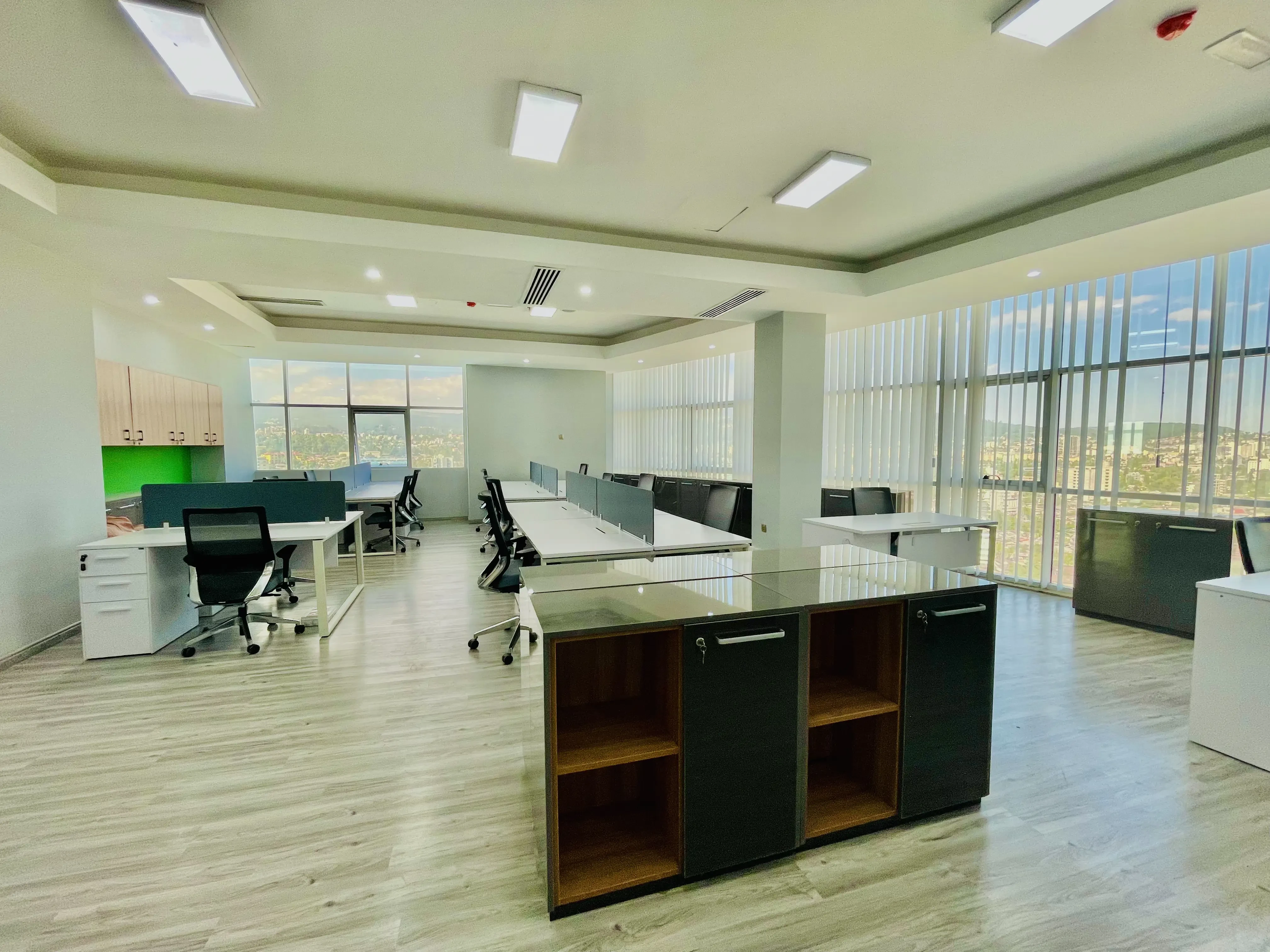
The "Linear 6" Configuration (360W x 150D cm):
This is the most efficient layout for open-plan teams in Addis. It allows 6 people to work in a total of 5.4 square meters (excluding aisles).
The "Linear 6" Configuration Breakdown
- Central Spine: 15cm wide. This must house the primary power trunks and data cables.
- Privacy Screens: 45H cm from desk surface. We use acoustic PET felt in Duka projects to dampen the "Bole Road traffic" noise.
- Leg Clearance: Minimum 65cm height under the frame to allow for mobile pedestals (drawers).
- Desk Depth per Person: 75cm (same as single desks)
- Width per Person: 60cm (optimized for Ethiopian body dimensions)
The Shared Walkway Rule: When placing two bench systems back-to-back, the "Dead Zone" between them must be 180cm. This allows two people to sit back-to-back while a third person walks between them—critical for smooth circulation in high-density layouts.
Ethiopian Benching Materials: For benching systems in Addis, we specify high-density particle board (HDPB) with 25mm thickness. Unlike MDF, HDPB resists swelling during the rainy season. The frame should be powder-coated steel (minimum 1.5mm thickness) to prevent rust in humid months.
Cable Management Reality: Ethiopian power outages average 2-3 times per month in commercial areas. Your benching spine must accommodate UPS units (minimum 30cm width allocation per 3 workstations). Plan for generator backup cables running under the floor—leave 10cm clearance between bench legs and floor tiles.
Local Manufacturing Tip: Addis workshops can fabricate benching systems for 40% less than imported solutions. However, insist on pre-finished panels—on-site painting in dusty workshop conditions leads to poor durability. Budget 15% more for quality control inspections during production.
03. Storage Engineering: More Than Just Cabinets
In Ethiopia, despite the push for "paperless" offices, legal and tax compliance still requires significant physical archiving. Storage is not just about holding files; it's about structural integrity.
The High-Capacity Wall Unit:
Dimensions: 240H × 90W × 45D cm.
At 240cm, you are utilizing the full vertical volume of the room.
Critical Spec: Shelving must be 25mm thick. Standard 18mm shelves will "bow" or sag under the weight of heavy Arch Lever files within 6 months.
Ethiopian Archival Reality: Ethiopian tax law requires 7-year retention of financial records. A medium-sized Addis company (50 employees) typically accumulates 3-4 tons of paper annually. Your storage system must handle this load without failure.
Material Specification:
- Shelving: 25mm HDPB with melamine finish (minimum 120g/m² paper weight)
- Frame: 1.8mm thick powder-coated steel (rust-resistant)
- Back Panel: 9mm MDF (provides lateral stability, prevents racking)
- Load Rating: 40kg per shelf (tested with Ethiopian Arch Lever files)
The Credenza (Executive Storage):
Dimensions: 180W × 45D × 75H cm.
This height is intentional—it aligns perfectly with the desk height, allowing the executive to extend their workspace laterally if needed.
Ethiopian Credenza Use Case: In Addis executive offices, credenzas often store ceremonial items (coffee sets, traditional gifts), confidential documents, and backup power equipment. The 45cm depth accommodates standard Ethiopian coffee ceremony sets (Jebena pot + cups) without protruding into walkways.
The "Clearance" Law
- 01. Drawer Swing: For a 45cm deep cabinet, you must leave 90cm of clear space in front. 45cm for the drawer + 45cm for the person standing.
- 02. Walkway Clearance: No storage within 120cm of primary circulation paths.
- 03. Maintenance Access: Leave 60cm behind tall units for HVAC and electrical access panels.
04. Meeting Room Furniture: Business Protocol
Meeting rooms in Addis offices serve multiple functions: client presentations, board meetings, team briefings, and ceremonial gatherings. The furniture must reflect business hierarchy while supporting modern collaboration tools.
The Boardroom Table (Power Dynamics):
Dimensions: 400W × 120D × 75H cm (for 12-14 people).
Business culture respects hierarchy. The head of table should be clearly defined. The 120cm depth allows comfortable placement of laptops, documents, and coffee service simultaneously.
Local Boardroom Table Materials: For executive boardrooms in Addis, we use solid Eucalyptus hardwood with book-matched veneer. The table should be 50mm thick to convey authority and stability. Avoid glass tops in boardrooms—they create glare under Addis sunlight and feel "cold" for Ethiopian hospitality culture.
Conference Room Chairs:
Seat Height: 48cm. Armrest Height: 68cm.
Armrests on conference chairs signal respect and status. The armrests must clear the table edge by 5cm to allow comfortable writing and laptop use.
Technology Integration: Meeting rooms in Addis must accommodate:
- • Projector Screens: Minimum 150" diagonal (Ethiopian meeting rooms are often deeper than Western standards)
- • Video Conferencing: Camera positioned at eye level for seated participants (120cm height)
- • Power Backup: UPS outlets at each seat for laptops during power outages
- • Coffee Service Station: Dedicated counter (180cm width) for traditional coffee ceremony equipment
Small Meeting Pods (4-6 people):
Dimensions: 240W × 120D cm table.
These intimate spaces are crucial for quick team huddles and private client conversations. The rectangular shape creates natural "head" and "foot" positions, useful for hierarchical discussions.
Meeting Room Checklist
- Min. Table Depth120 cm
- Chair Width60 cm per person
- Walkway Clearance90 cm
- Ceiling Height270 cm min.
- Power Outlets1 per 2 seats
- Acoustic Treatment40% wall coverage
- Coffee Station180 cm width
05. Reception & Lobby Furniture: The First Impression
The reception area is your company's handshake. In business culture, where first impressions carry significant weight, your lobby furniture must communicate professionalism, hospitality, and stability.
The Reception Desk (The Face of Your Company):
Dimensions: 240W × 80D × 110H cm (counter height).
The 110cm counter height creates a subtle barrier that defines the receptionist's workspace while remaining approachable. The 80cm depth accommodates receptionist equipment (computer, phone, visitor logbook) without feeling cramped.
Ethiopian Reception Desk Materials: For lobby desks in Addis, we recommend solid surface material (like Corian) or high-gloss laminate. These materials resist stains from coffee spills and are easy to clean—critical for high-traffic reception areas. The base should be powder-coated steel or hardwood to support the heavy countertop.
Visitor Waiting Area:
Seating Capacity: 6-8 people minimum.
Business meetings often involve multiple stakeholders arriving together. Your waiting area must accommodate groups of 4-6 people comfortably. Provide a mix of 2-seater sofas and individual armchairs to allow flexible seating arrangements.
Cultural Considerations:
- • Respect for Elders: Include at least 2-3 armchairs with higher seat heights (45cm) for elderly visitors who may have difficulty standing from low sofas
- • Hospitality Station: Dedicate 120cm counter space for coffee service (water dispenser, cups, traditional coffee setup)
- • Privacy Screening: Use partial-height screens (120cm) to create semi-private waiting zones for competing companies or sensitive discussions
- • Bag Storage: Provide open shelving or coat racks—Ethiopian visitors often carry briefcases, laptops, and personal items
Lighting for Addis Lobbies: Ethiopian sunlight is intense. Your lobby lighting must balance natural light with artificial sources. Use dimmable LED panels (4000K color temperature) to complement daylight without creating harsh shadows. Position seating away from direct window glare—sun angles create strong contrasts that strain visitor eyes.
06. Room Size Standards: Open Plan vs. Private
Office room sizing is critical for both functionality and cost efficiency. Here are the proven dimensions that work in Addis Ababa offices:
Open Plan Workstations
- • Per Person: 8-10 square meters (including circulation)
- • Desk Area: 1.2m × 0.75m per person
- • Aisle Width: 120cm minimum between rows
- • Ceiling Height: 270cm minimum for visual comfort
- • Partition Height: 120-150cm for privacy without isolation
- • Power Access: 1 outlet per 1.5 meters of benching
Private Offices
- • Single Office: 12-15 square meters
- • Manager Office: 18-22 square meters
- • Executive Office: 25-35 square meters
- • Door Width: 90cm minimum
- • Window Access: Minimum 1.5m window width for natural light
- • Storage Space: 20% of room area dedicated to storage
Meeting Rooms
- • Small (4-6 people): 15-20 square meters
- • Medium (8-12 people): 25-35 square meters
- • Large (14-20 people): 40-50 square meters
- • Boardroom (20+ people): 60+ square meters
- • Table-to-Wall: 120cm minimum clearance
- • AV Equipment: 3m × 2m dedicated space for projector/screen
Breakout & Canteen
- • Breakout Zone: 10-15 square meters per 8 people
- • Canteen: 1.5 square meters per person (seated)
- • Kitchenette: 8-12 square meters minimum
- • Circulation: 150cm between tables
- • Sink Area: 120cm × 90cm per sink
- • Refrigerator Space: 90cm width × 70cm depth
Open Plan Layout Guidelines:
- • Team Pods: Group 6-8 workstations together with shared resources
- • Quiet Zones: Dedicate 15% of open plan area for focused work
- • Collaboration Areas: Place near circulation paths for easy access
- • Natural Light: Position desks within 6 meters of windows
- • Acoustic Treatment: 40% ceiling coverage + 25% wall coverage minimum
07. Lighting Standards: Illuminating Ethiopian Offices
Proper lighting is essential for productivity, eye health, and creating the right atmosphere. Ethiopian offices face unique challenges with intense natural light and the need for artificial lighting during frequent power outages.
General Office Lighting
- • Lux Level: 300-500 lux for general work areas
- • Color Temperature: 4000K (neutral white)
- • Spacing: LED panels every 2-3 meters
- • Mounting Height: 240-270cm from floor
- • Uniformity Ratio: Maximum 3:1 (brightest to dimmest)
- • Glare Control: UGR (Unified Glare Rating) below 19
Task Lighting
- • Lux Level: 500-750 lux for detailed work
- • Desk Lamps: 300-500 lumens per workstation
- • Position: 40-50cm above desk surface
- • Color Temperature: 4500K (cool white)
- • Adjustability: 180° horizontal, 90° vertical movement
- • CRI Rating: Minimum 80 (Color Rendering Index)
Meeting Rooms
- • Lux Level: 250-350 lux (softer atmosphere)
- • Color Temperature: 3500K (warm white)
- • Dimmable: Essential for presentations
- • Accent Lighting: 150 lux on walls for depth
- • Table Lighting: Pendant lights 75cm above table
- • Emergency Lighting: 50 lux minimum during outages
Reception & Lobby
- • Lux Level: 200-300 lux (welcoming)
- • Color Temperature: 3000K (warm white)
- • Feature Lighting: Spotlights on logo/artwork
- • Ambient: Indirect lighting for comfort
- • Wall Wash: 100 lux on feature walls
- • Pathway: 150 lux along main circulation
Types of Lights Used in Ethiopian Offices:
- • LED Panel Lights: Primary overhead lighting, energy efficient, 50,000 hour lifespan, 120-150 lumens per watt
- • LED Downlights: For accent lighting, corridors, and focused areas, recessed mounting, 80-100 lumens per watt
- • LED Strip Lights: Under desk lighting, cove lighting, ambient effects, flexible installation, 90-110 lumens per watt
- • Desk Lamps: Adjustable arm lamps for task lighting at workstations, 300-500 lumens, USB or mains powered
- • Track Lighting: For highlighting artwork, product displays, or architectural features, adjustable heads, 80-100 lumens per watt
- • Pendant Lights: For meeting rooms and breakout areas, suspended mounting, decorative options available
- • Emergency Lighting: Battery-backed lights for power outage safety (minimum 3 hours runtime), automatic activation
- • Outdoor/Security Lighting: For building perimeter, parking areas, entrance zones, motion sensor activated
Lighting Control Systems:
- • Dimmer Switches: Allow adjustment of light levels for different activities
- • Motion Sensors: Automatically turn off lights in unoccupied areas
- • Daylight Harvesting: Sensors that dim artificial lights when natural light is sufficient
- • Scene Control: Pre-programmed lighting scenes for meetings, presentations, cleaning
- • Central Management: Building-wide control system for energy efficiency
08. Spacing Between Furniture: The Circulation Matrix
Proper spacing between furniture is critical for smooth movement, accessibility, and creating a professional atmosphere. Here are the proven clearance standards:
Workstation Spacing
- • Between Desks: 120cm minimum (allows chair movement)
- • Behind Chairs: 90cm minimum (walkway clearance)
- • Between Rows: 150cm for two-way traffic
- • From Wall: 60cm minimum (cleaning access)
- • Monitor Distance: 50-70cm from eyes to screen
- • Keyboard Position: Elbows at 90°, wrists straight
Meeting Room Spacing
- • Chair to Table: 65-70cm (comfortable seating)
- • Behind Chairs: 100cm minimum (walkway)
- • Between Tables: 120cm minimum
- • From Wall: 80cm minimum
- • Presentation Space: 200cm clearance in front of screen
- • Coffee Service: 90cm × 90cm dedicated area
Reception Area Spacing
- • Reception Desk to Waiting: 150cm minimum
- • Between Seating: 80cm (conversation distance)
- • Walkway to Door: 120cm minimum
- • Bag Drop Area: 90cm × 90cm per visitor
- • Information Counter: 120cm width minimum
- • Signage Visibility: 300cm clear line of sight
Storage & Cabinets
- • Drawer Pull Space: 90cm in front of cabinets
- • Door Swing: 90cm clearance for hinged doors
- • Between Units: 60cm minimum (access)
- • From Ceiling: 45cm minimum (visual balance)
- • Heavy Items: Store below 150cm height
- • Filing Access: 75cm clearance for pulling files
Circulation Path Guidelines:
- • Primary Aisles: 150cm minimum width for main circulation
- • Secondary Aisles: 100cm minimum width for department access
- • Emergency Exits: 120cm minimum clearance at all times
- • Door Swings: 90cm clearance in direction of swing
- • Elevator Lobbies: 200cm × 200cm waiting area minimum
- • Stair Landings: 150cm × 150cm minimum at each floor
Accessibility Considerations:
- • Wheelchair Turning: 150cm diameter clear space required
- • Ramp Slope: Maximum 1:12 gradient for accessibility
- • Door Width: 90cm minimum clear opening
- • Counter Height: 75-85cm for wheelchair users
- • Reach Ranges: 40-120cm from floor for controls
- • Tactile Indicators: At stairs, ramps, and hazards
09. Soft Seating & The Physics of Comfort
Visitor seating in an Addis lobby creates the first impression. But comfort is a mathematical formula of seat-to-back ratios. In Ethiopian business culture, where hospitality is paramount, your seating must communicate respect and care.
The Reception Sofa:
Seat Height: 42cm. Seat Depth: 55cm.
If the seat is deeper than 60cm, visitors will "sink" in, making it difficult to stand up professionally when called for a meeting. We use high-density 32kg/m³ foam to ensure the sofa retains its shape after years of use.
Ethiopian Foam Reality: Local foam manufacturers in Addis produce 28-32kg/m³ density foam. Avoid anything below 28kg/m³—it compresses permanently within 6 months under daily use. For executive reception areas, specify 35kg/m³ foam.
The Collaborative Lounge Chair:
Dimensions: 80W x 80D cm.
These require a "Circulation Ring" of 120cm around them. Placing lounge chairs too close to a doorway creates a psychological barrier that prevents people from actually using them.
Ethiopian Social Dynamics: In Addis business culture, informal conversations often happen in lounge areas over coffee. Provide small side tables (45cm height) within arm's reach of lounge chairs for coffee cups and documents.
Fabric Selection: Choose fabrics with 15,000+ double-rub rating for high-traffic areas. For Addis, we recommend crypton fabric or performance velvet—both resist stains from coffee spills and withstand dry-season static electricity.
Ethiopian Soft Seating Specifications
- • Frame: Hardwood (Eucalyptus/Birch) or powder-coated steel
- • Foam Density: 28kg/m³ minimum (32kg/m³ for executive areas)
- • Fabric: 15,000+ double-rub rating, stain-resistant
- • Leg Height: 15cm minimum (allows easy cleaning under furniture)
- • Weight Capacity: 150kg per seat (tested for Ethiopian body weights)
- • Armrest Height: 60-65cm from floor
10. Breakout & Canteen Areas: The Social Engine
In the modern Addis office, the canteen is no longer just for lunch—it's a "Third Space" for informal meetings. However, the acoustics of hard surfaces (tiles and laminate tables) can make these areas unusable if the dimensions don't account for voice-buffer zones.
Ethiopian Canteen Culture: In Addis companies, the canteen serves multiple functions: lunch breaks, coffee ceremonies (Buna), team celebrations, and impromptu brainstorming sessions. Your furniture must support all these activities without creating chaos.
The High-Top Community Table
Standard: 240W x 70D x 105H cm
By making the table 105cm high, you encourage "perching." This allows employees to stand and talk to those seated on 75cm bar stools at eye level. This parity of eye height is the secret to successful collaboration zones.
Ethiopian Coffee Ceremony Integration: Position high-top tables near electrical outlets for traditional coffee brewing (Jebena pots require hot plates). Allow 90cm clearance around each table for the coffee server to move comfortably.
The Canteen Grid
Clearance: 120cm between parallel tables
You must allow 60cm for a chair to be pulled out, plus an additional 60cm for a person carrying a tray to walk behind that chair. In tight Addis floorplans, designers often cheat this to 90cm, leading to constant chair-bumps and spills.
Peak Hour Flow: Addis offices typically have 30-minute lunch windows (12:30-1:00 PM). Your canteen layout must handle 60-70% of staff simultaneously. Calculate: (Total Staff × 0.65) ÷ 4 people per table = minimum table count needed.
Local Canteen Furniture Materials: For canteen tables in Addis, specify high-pressure laminate (HPL) tops with 1.2mm wear layer. This withstands daily abuse from hot coffee cups, lunch trays, and cleaning chemicals. Table bases should be powder-coated steel (minimum 2mm thickness) to resist rust from spilled liquids.
Ethiopian Food Service Considerations: Traditional Ethiopian meals (Injera with Wat) require larger plates and shared platters. Standard Western table spacing (75cm between chairs) is insufficient—allow 80cm minimum to accommodate shared food platters and comfortable eating posture.
Full Technical Pack
Our 2026 Technical Pack includes CAD blocks, material load-bearing specs (HDF vs. MDF), and detailed furniture specifications used by Duka Interiors on every project.
Notify me when available: Telegram @dukainteriorsplc
Need Professional Finishing?
Request a technical site visit for your office project.